

May 27, 2026
The Art of War in Business: Sun Tzu’s Strategy, Applied, Not Just Quoted
Most Art of War content stops at the quotes. This applies it as real business strategy, win before you fight, attack weakness, use tempo, and rehearse the move in a wargame, with examples from real engagements.
By Mark Hope, Founder, President & Chief Strategy Officer, Asymmetric Marketing

Every other version of this article stops at the quotes. You know the ones: "subdue the enemy without fighting," a tidy list of ten lessons, a Tesla anecdote, done. We're going to do the part they skip: how you actually use The Art of War as business strategy against a real competitor, on a real Tuesday, when budget is finite, and the other guy is bigger than you.
I've spent ten years running competitive strategy and business wargames, about twenty engagements, across industries as different as venture-backed biotech and global consumer brands. What that work teaches you is that The Art of War isn't a book of motivational lines. It's an operating system for asymmetric competition: winning by attacking where a rival is weak instead of where they're strong. That's not a metaphor for us. It's literally what we're named for.
So this piece translates a 2,500-year-old text into the decisions a growth leader actually makes, positioning, pricing, channel, and timing, the real substance of Art of War business strategy, and shows how we pressure-test those decisions in a wargame before a competitor ever sees them. The quotes are easy to find. Using them is the hard part. That's what's below.
Key takeaways
- The Art of War as business strategy is an operating system for asymmetric competition: win by attacking where a rival is weak, not where they're strong.
- Win before you fight: choose a position where you don't have to outspend the incumbent, rather than meeting them head-on.
- Know yourself and the enemy: disciplined competitive intelligence, and an honest read of your own weakness, is where strategy lives.
- Attack weakness, not strength: the winning move is usually a decision about where not to fight.
- Speed, terrain, timing, and a unified team turn principle into advantage, and a business wargame is how you rehearse it before the market does.
Win before you fight: strategy as pre-emption
Sun Tzu's most quoted line, subdue the enemy without fighting, is also the most misread. It doesn't mean avoid competition. It means winning the positioning battle before the spending battle begins. Choose a place to compete where you don't have to outspend the incumbent to win.
The concrete version: category design, sharp differentiation, and segment focus beat head-to-head ad-spend wars almost every time, because spend wars favor whoever has the deepest pockets, and that's rarely the challenger.
Case in point. A venture-backed biotech with proprietary CRISPR technology came to us planning to build a diagnostic tool. On paper, it was viable. In a wargame, it wasn't: diagnostics meant a longer, costlier path into a crowded, well-defended field, exactly the kind of fight where limited capital gets neutralized before it produces any advantage. So they didn't take it. They restructured the company around unique therapeutic products instead, competing where their IP was genuinely differentiated and preserving runway for a fight they could actually win. The strongest move on the board was the one they chose not to make. (Details anonymized under NDA.)
Know yourself and know the enemy: competitive intelligence
"If you know the enemy and know yourself, you need not fear the result of a hundred battles." This is the case for disciplined competitive intelligence, not occasional competitor-gawking, but a standing read on rival positioning, pricing, messaging, and weaknesses.
The discipline is in the second half: knowing yourself. Most companies can describe their competitors. Far fewer can honestly name where their own positioning has gone generic, where their pricing is indefensible, where a sharper rival could cut them. The gap between those two reads, what they're weak at and what you're weak at, is where strategy actually lives, and a structured competitor analysis is how you find it.
Attack weakness, not strength (the asymmetric core)
"Avoid what is strong, strike at what is weak." This is the asymmetric core, and it's the principle most often abandoned the moment real money is on the table, because attacking strength feels brave and attacking weakness feels like cheating. It isn't. It's the entire point, and it's the foundation of asymmetric marketing.
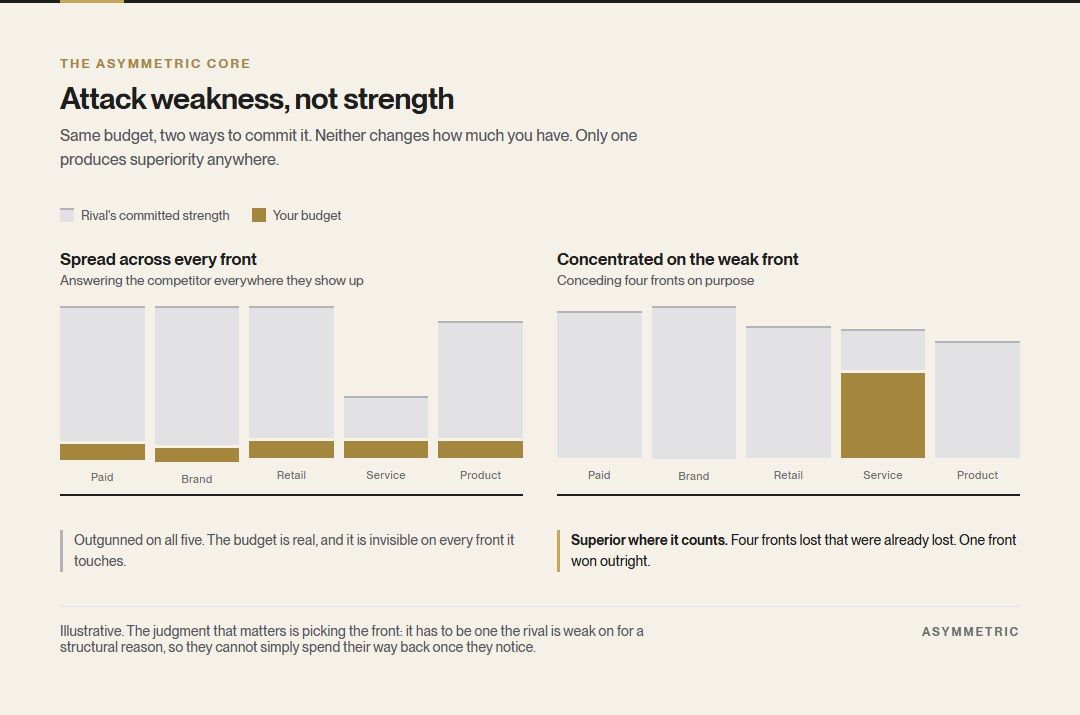
A global beverage manufacturer we worked with was bleeding share and revenue to startups and private-label brands competing on price and novelty. The instinct in the room was to defend the legacy portfolio head-on: more variants, more bundles, match them move for move. That's attacking strength, a price-and-scale fight against players built to win exactly that fight.
The wargame redirected them. Instead of defending everywhere, they shifted to a healthier alternative product line with better market fit, higher margins, and less competition. They kept supporting the traditional products, but changed the objective there from growth to maintenance, stopping the bleed without pouring fresh resources into a battle they could at best tie. Resources freed, redeployed to a battlefield they could win. The erosion stopped. (Details anonymized under NDA.)
Notice what both of those companies have in common: the winning move was a decision about where not to fight.
Speed, terrain, momentum, and timing
Sun Tzu is obsessed with terrain and timing: "the quality of decision is like the well-timed swoop of a falcon." In modern terms, market timing, channel terrain, and speed of execution are weapons in their own right. Entering an emerging channel before it saturates is a terrain advantage. Shipping a campaign faster than a slower competitor can respond is a tempo advantage. Neither requires a bigger budget, only better judgment about when and where to move.
Sun Tzu had a word for the thing those advantages compound into: shih, usually translated as momentum or energy. His image is "rolling round stones down a mountain thousands of feet in height," a force that looks effortless because the work went into engineering the position first, not into the push. Momentum is manufactured before it's spent. A challenger who picks the right terrain and the right moment can generate momentum a better-funded incumbent simply can't arrest, which is the closest business comes to the oldest principle in military strategy: concentrate force where it decides the outcome, and nowhere else. Seizing that opportunity is a question of timing and judgment, not budget.
Deception and the unexpected
"All warfare is based on deception." Read this as unpredictability, not dishonesty. The strategic sin isn't being honest with customers: it's being predictable to competitors. If a rival can forecast your next campaign, your next price move, your next launch window, you've handed them the initiative. Keep your moves legible to the market and opaque to the people trying to counter them.
Leadership, discipline, and the team
Sun Tzu devotes as much attention to the general and the troops as to the enemy: "He will win whose army is animated by the same spirit throughout all its ranks." The best competitive plan in the world dies on a misaligned team. Strategy isn't the deck: it's whether the people who have to execute it understand it, believe it, and move together. That alignment problem, as much as the analysis problem, is what the next section is built to solve.
From principle to practice: the business wargame
Here's where most Art of War content stops, and where ours starts. Reading Sun Tzu doesn't change outcomes. Rehearsing the battle does.
A business wargame is a structured exercise in which your own team stress-tests your strategy against the competitors who'll try to beat it, before you commit a dollar of budget to it. Here's how we run one.
Two full days. Around 24 cross-functional participants, senior leadership included, because the people who'll execute the strategy need to be in the room when it's tested, not briefed on it afterward. We split the group into three teams: one plays the company, the other two play your most important competitors. Then we run the strategy through live rounds of move and response: the company team makes a thrust, the competitor teams react the way those rivals actually would, and everyone watches what happens.
What happens is usually uncomfortable, and that's the value. In one recent wargame, the company team opened with the conventional playbook: new product variants, bundled packages, and the standard moves. In round one, both competitor teams did exactly the same thing: every advantage canceled out, and the futility was visible to everyone in the room. That stalemate was the unlock. In round two, the team stopped trying to win the head-to-head fight and designed an alternative product solution instead, winning without fighting. The wargame didn't hand them the answer. It made the dead end of the conventional path undeniable, which is what freed them to find the asymmetric one.
That's the whole of Sun Tzu in a sentence: know the enemy, win before you fight, attack weakness, discovered not on a slide, but by exhausting the alternatives in a room where it's safe to be wrong.
Further reading: the strategy canon
The Art of War is the foundation, not the whole canon. A few books that genuinely add something Sun Tzu doesn't, one opinionated line each on what you get:
- Carl von Clausewitz, On War: where Sun Tzu prizes winning without fighting, Clausewitz insists on friction and the fog of the real fight. Read him for the humility: plans survive contact with the enemy badly.
- John Boyd, the OODA loop: Sun Tzu tells you to be fast; Boyd tells you how speed wins, by getting inside a competitor's decision cycle until they're always reacting to a situation that's already changed. The operational engine behind tempo as a weapon.
- Michael Porter, Competitive Strategy: the rigorous modern complement, five forces, generic strategies, and the discipline of choosing a defensible position instead of trying to be good at everything.
- Clayton Christensen, The Innovator's Dilemma: the one Sun Tzu couldn't have written, how strong incumbents lose not by being attacked head-on but by being undercut from below. The asymmetric playbook seen from the disruptor's side.
Sun Tzu gives you the philosophy of asymmetry. These give you the friction, the tempo, the rigor, and the mechanics of disruption. Together they're a strategic education.
The Strategic Impact of the Art of War Rules
Integrating the Art of War principles into your business strategy can create a more resilient and adaptable organization. These principles encourage proactive thinking, resourcefulness, and a keen awareness of the competitive environment-traits key for long-term success in any industry.
Incorporating the Art of War into your business philosophy isn’t about following a rigid set of rules but embracing a strategic flexibility mindset. The 13 principles of the Art of War provide a foundational framework you can build upon, adapting the rules to meet the specific demands of your market.
To be successful in business, you need to take the initiative and act proactively instead of waiting for opportunities or problems to arise. Creating a business model that adequately considers competitive challenges is also key.
Reacting to situations usually results in poor decisions or waiting too long to take advantage of opportunities. Being proactive allows you to seize control of the situation and create opportunities.
By following the principles of the Art of War principles, you can improve your chances for business success and achieve greater success. Whether you're working to gain market share, improve your market penetration, or grow your profits, these timeless principles will help you achieve your goals.
Another important lesson from Art of War is the importance of business strategy. To be successful, you need to have a plan and be willing to make adjustments as needed.
There's no one-size-fits-all solution in business strategy, so as a business owner, it's important to be flexible and adapt your strategy as needed.
Business competition can be a significant obstacle to your success, so using the principles in the Art of War is important to winning in direct conflict.
Sun Tzu’s text can help you develop a strategic mindset and give you the tools you need to succeed. Like any military operation, your business strategy must be well-planned and well-executed.
The Art of War is a great place to start if you want to improve your business skills. By learning the principles of military strategy from this ancient text, you can gain an edge over your competition and achieve greater business success.
The Art of War remains a classic. It’s not just a military strategy masterpiece in the same way that Thucydides’ Peloponnesian War is a classic.
The Art of War might as well be called The Art of Life since it advises readers to avoid war because it's too expensive and can't be substituted for diplomacy and long-term strategies. The outcome of the war is uncertain due to all the inherent variables.
Contemporary Principles of Military Strategy
Sun Tzu’s principles in the Art of War have been adapted and adopted by modern-day generals and other military leaders.
- The first principle is to know your enemy. This means understanding your competitors and their strategies for competing against you in business. You need to be aware of their strengths and weaknesses and develop strategies to exploit them while protecting your strengths.
- Another key principle is to keep your options open. This means being flexible and willing to adapt to changing circumstances in business. You need to seize opportunities when they arise and be prepared to take quick action to capitalize on them.
- The third principle is deception. In business, this means being able to mislead your competitors about your true intentions or plans. You can do this by making false statements or by hiding information from them. You can gain a strategic advantage by keeping your competitors in the dark.
- The fourth principle is to use timing. In business, this means knowing when to take action and when to hold back. You need to know your industry’s current market conditions and trends. You must also time your moves carefully to avoid missing out on opportunities. Timing makes all the difference.
- The fifth principle is the concentration of force. In business, this means using your resources to achieve a common goal. You need to focus on what is most important and avoid spreading yourself too thin. By concentrating your resources, you can achieve greater results than if you were to do everything yourself.
- The sixth principle is the economy of force. This means using the fewest resources possible to achieve your business goals. You need to be efficient with your time and money and ensure that every action you take contributes to your overall goal.
- The seventh principle is surprise. In business, this means attacking your opponents when they're not expecting it. You can do this by launching a sneak attack or making an unexpected move. By surprising your opponents, you can catch them off guard and gain an advantage.
- The eighth principle is the unity of command. In business, this means having one person in charge of all aspects of the operation. This ensures a clear chain of command and everyone is working towards the same goal.
- The ninth principle is simplicity. In business, this means keeping your plans and strategies simple. You don’t want to overload your employees with too much information or make it difficult for them to understand what you're trying to do. By keeping things simple, you can ensure everyone agrees and knows their role in achieving your goals.
- The tenth principle is security. In business, this means protecting your assets and preventing opponents from gaining an advantage. You need to have a sound security system in place to keep your data safe and be prepared for any attacks that may come your way. Securing your position can minimize your risk of losing out on opportunities or profits.
Run the wargame, don't just read the book
If you want to apply this against a specific competitor, name the rival, pressure-test the plan, and find the asymmetric move before you spend a dollar proving it, that's exactly what we do.
Frequently asked questions
Is The Art of War good for business strategy?
Yes, when it's applied rather than quoted. The Art of War is an operating system for asymmetric competition: winning by attacking where a rival is weak instead of where they're strong. Its principles, win before you fight, know yourself and the enemy, attack weakness, and use speed and timing, translate directly into positioning, pricing, channel, and timing decisions for a business.
What are the key Art of War lessons for business?
Win before you fight by choosing a position you don't have to outspend to hold; know the enemy and yourself through disciplined competitive intelligence; attack weakness, not strength, since the winning move is usually a decision about where not to fight; use speed, terrain, and timing as weapons; keep your moves unpredictable to competitors; and align the team that has to execute.
What does 'subdue the enemy without fighting' mean in business?
It doesn't mean avoid competition. It means winning the positioning battle before the spending battle begins, choosing a place to compete where you don't have to outspend the incumbent to win. Category design, sharp differentiation, and segment focus beat head-to-head ad-spend wars, which favor whoever has the deepest pockets.
How do you apply The Art of War to business strategy in practice?
Translate the principles into concrete decisions, then rehearse them. We pressure-test a strategy in a business wargame: cross-functional teams role-play the competitors and run the plan through rounds of move and counter-move before any budget is committed. That turns Sun Tzu's philosophy of asymmetry into a tested decision rather than a motivational quote.
What other strategy books should I read with The Art of War?
The Art of War is the foundation, not the whole canon. Pair it with Clausewitz's On War for friction and the fog of real conflict, John Boyd's OODA loop for tempo, Michael Porter's Competitive Strategy for rigor and defensible positioning, and Clayton Christensen's The Innovator's Dilemma for the mechanics of disruption from below.
What are the five principles of The Art of War?
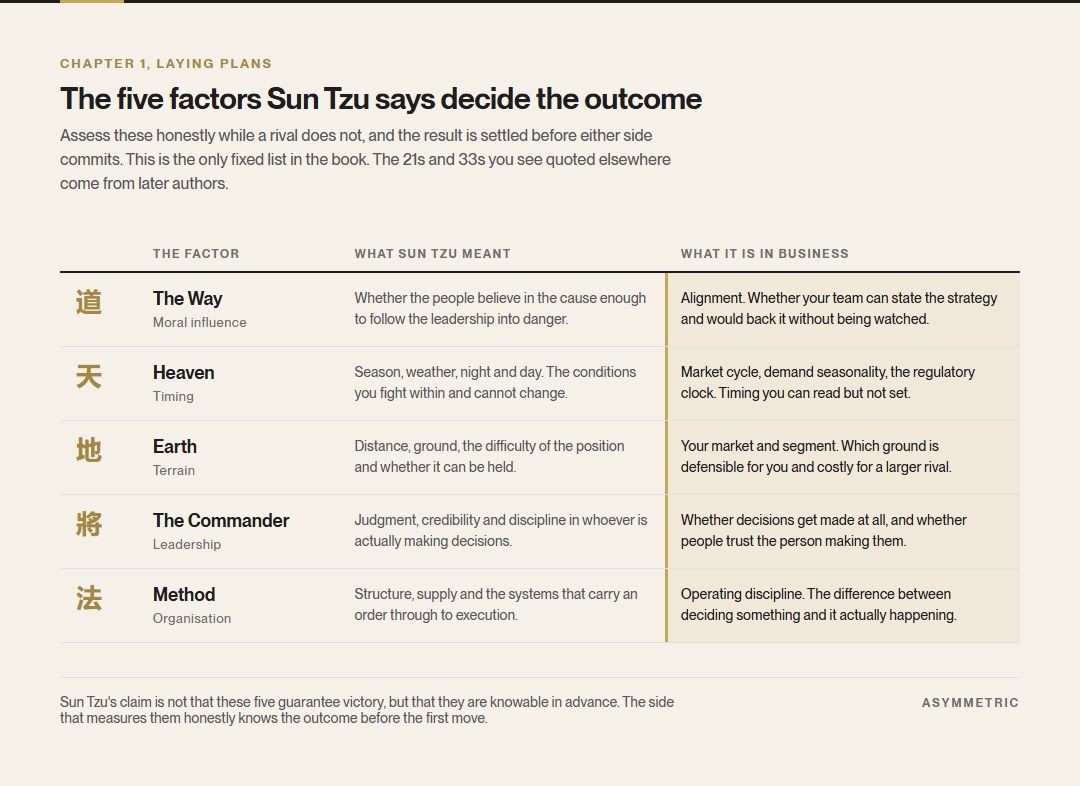
Sun Tzu opens the book with five factors that decide the outcome before fighting starts: the Way (whether your people believe in the cause and will follow the leadership), Heaven (timing and conditions you don't control, such as the season or the market cycle), Earth (the terrain you're fighting over, including its distance and difficulty), the Commander (the judgment, discipline and credibility of whoever is leading), and Method (organisation, logistics and the systems that carry a decision out). In business the translation is direct: alignment, timing, market, leadership and operating discipline. Sun Tzu's point is that if you assess these five honestly and your rival does not, you know the result before either of you commits.
How many chapters and principles does The Art of War actually have?
The Art of War has thirteen chapters, and that's the only number in it that's fixed. The five factors come from Chapter 1. Everything else you see quoted, whether that's 21 principles, 33 strategies or 9 rules, comes from a later author organising the material their own way rather than from Sun Tzu. The 33 Strategies of War, for instance, is Robert Greene's book, not a section of Sun Tzu. This matters when you're trying to apply the text: chase a numbered list somebody invented for a blog post and you get a summary, whereas the thirteen chapters give you the actual argument in the order Sun Tzu made it.
What are the main lessons of The Art of War for a smaller competitor?
Three of them do most of the work when you're outspent. Win before you fight, meaning choose a position you can hold without matching a larger rival's budget. Attack weakness rather than strength, because a well-funded competitor isn't strong everywhere and the gaps are usually structural rather than accidental. And know both sides, since most companies research their own market properly and their competitors barely at all. The lesson a smaller competitor should ignore is the one about overwhelming force, which is written for the side that already has it.
How can “The Art of War” principles be applied to modern business?
The principles of “The Art of War” can be applied to modern business using its strategic insights to handle competition, manage resources, and make informed decisions. Key applications include: Strategic Planning: Analyzing the competitive market and positioning your business effectively. Resource Management: Efficiently utilizing resources to maximize impact. Leadership: Leading with wisdom and adaptability to inspire and guide teams. Competitive Advantage: Identifying and using unique strengths to gain an edge over competitors.
How can leaders foster a culture of strategic thinking inspired by “The Art of War”?
Leaders can foster a culture of strategic thinking by: Encouraging Continuous Learning: Promoting the study of strategic texts and market analysis. Facilitating Open Communication: Creating an environment where team members can share insights and ideas. Modeling Strategic Behavior: Demonstrating strategic thinking through leadership decisions and actions. Incorporating Strategic Planning: Making strategic planning a regular part of business operations and decision-making processes.
About the author

Mark Hope
Founder, President & Chief Strategy Officer, Asymmetric Marketing
Mark Hope is the Founder, President & Chief Strategy Officer of Asymmetric Marketing. His career spans elite military service, senior leadership at two of the largest companies in their categories, and founding several companies of his own. It's the common thread behind how Asymmetric helps smaller companies out-compete bigger ones.
Mark began his career in U.S. Army Special Operations, serving from 1977 to 1988 in the 1st and 3rd Battalions of the 75th Ranger Regiment and as an Operator in 1st Special Forces Operational Detachment–Delta (Delta Force). What that world runs on (careful planning, reading your opponent, and winning from a position of disadvantage) is the foundation of how he helps smaller companies win today.